
Superannuation limits: what’s changing from 1 July 2026

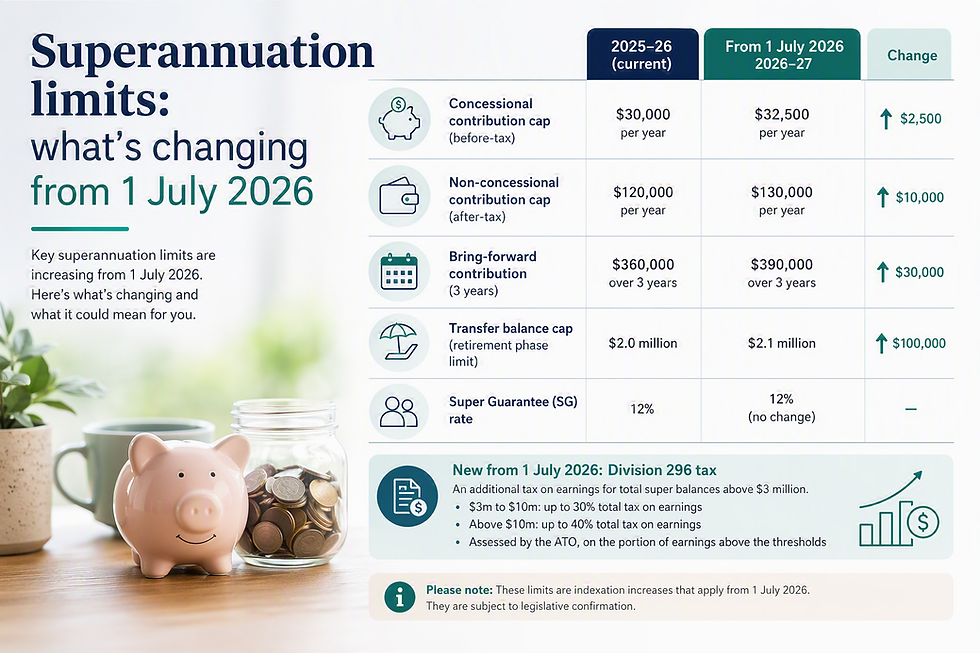
From 1 July 2026, several key superannuation limits will increase due to indexation. These changes follow a period of stable limits in the 2025–26 financial year and may affect how much you can contribute and your eligibility for certain rules.
Below is a comparison of the current limits and what is changing.
Concessional contribution cap (before‑tax contributions)
Concessional contributions include employer Super Guarantee (SG), salary sacrifice, and personal contributions you claim as a tax deduction.
2025–26 financial year - $30,000 per year
From 1 July 2026 (2026–27): $32,500 per year
What’s changed:
An increase of $2,500 per year. The higher cap also increases the amount available under the carry‑forward (catch‑up) rules, if eligible.
Non‑concessional contribution cap (after‑tax contributions)
Non‑concessional contributions are made from after‑tax income and are not taxed when entering super.
2025–26 financial year: $120,000 per year
From 1 July 2026 (2026–27): $130,000 per year
What’s changed:
An increase of $10,000 per year. This cap is linked to the concessional cap (generally set at four times the concessional limit).
Bring‑forward contribution rules
The bring‑forward rule allows you to contribute up to three years of non‑concessional contributions in one year, depending on your total super balance.
2025–26 financial year limits: Up to $360,000 over three years
From 1 July 2026 (2026–27): Up to $390,000 over three years
What’s changed:
Higher contribution limits as a result of higher non-concessional contribution caps (above).
Importantly, once you trigger a bring‑forward period, your limits remain tied to the rules at that time.
Transfer balance cap (retirement phase limit)
The transfer balance cap is the maximum amount you can move into a tax‑free retirement income stream.
2025–26 financial year: $2.0 million
From 1 July 2026 (2026–27): $2.1 million
What’s changed:
An increase of $100,000, indexed to inflation (CPI).
This change also increases the total super balance thresholds, which affect:
Eligibility for non‑concessional contributions
Bring‑forward access
Other contribution rules
Super Guarantee (SG)
The SG is the compulsory employer contribution rate. This remains at 12% with no further increases scheduled. The Superannuation Guarantee has now reached its legislated maximum.
Other relevant thresholds
A number of additional limits and rules are also updated from 1 July 2026:
Total super balance cap: increases to $2.1 million (linked to the transfer balance cap)
Division 293 tax threshold: remains at $250,000
Division 296 tax (new from 1 July 2026)
From 1 July 2026, a new tax framework—known as Division 296—applies to individuals with higher superannuation balances.
Applies where your total super balance exceeds $3 million
Introduces an additional 15% tax on earnings attributable to the portion of your balance above this threshold
For balances above $10 million, an additional 10% tax (on top of the 15%) applies to that portion of earnings
In simple terms:
Earnings on amounts below $3 million continue to be taxed under existing super rules
Earnings on amounts between $3 million and $10 million may face up to 30% total tax (including existing tax)
Earnings on amounts above $10 million may face up to 40% total tax.
Additional points:
The tax is assessed personally by the ATO, not paid directly by your super fund
It applies only to the portion of earnings linked to balances above the thresholds, not your entire account
The thresholds are indexed over time in line with inflation
Key Summary
From 1 July 2026, indexation increases most major limits, including:
Higher annual contribution caps
Expanded bring‑forward opportunities
A higher transfer balance cap and related thresholds
The introduction of Division 296, which applies additional tax to very large super balances
While the increases are modest for most people, the changes may improve flexibility around contributions and highlight how superannuation rules continue to evolve over time.
If you have any queries about how the changes to contribution limits impact your position and strategies, please don't hesitate to contact us.

Comments